


HEBI Robotics Case Study
Haptic Control for Industrial Teleoperation
In the process of developing a teleoperated robotic system for a US-based metals supplier, HEBI engineers discovered a problem: existing haptic control systems lacked the flexibility required for their needs.
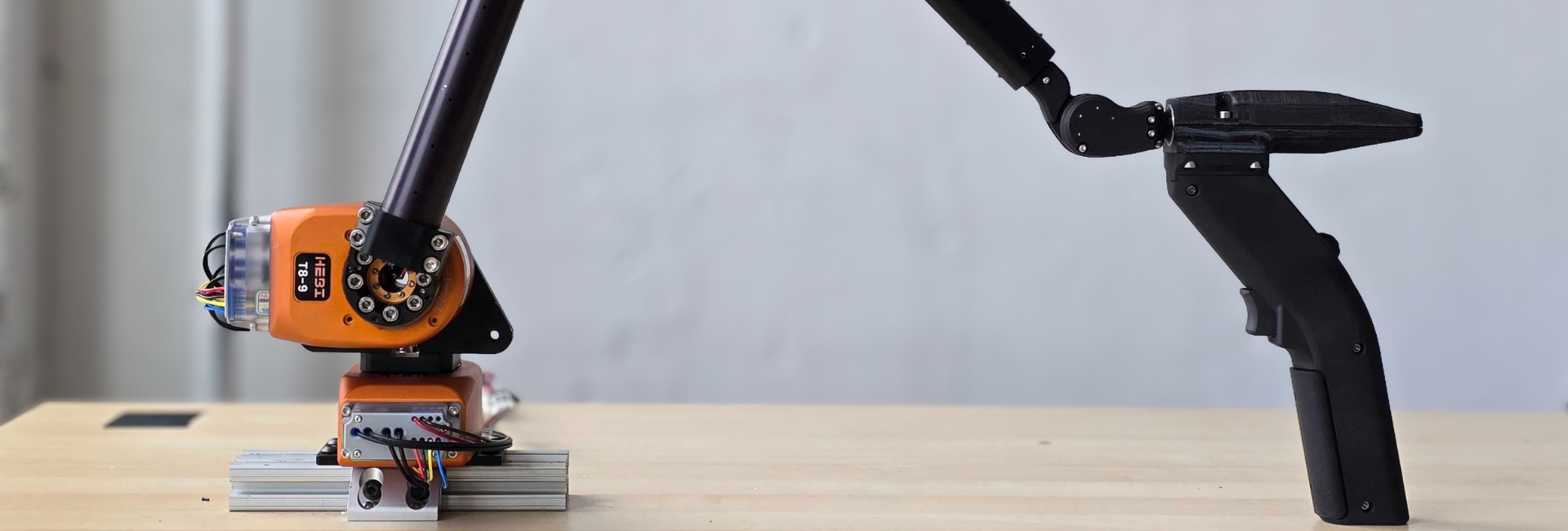
The HEBI Haptic Arm was developed out of a need to create a solution for one customer, but the applications go far beyond a single use case.
Download this case study
or continue reading below.
The Opportunity
Teleoperation for robot arms generally falls into some combination of three broad categories: camera/VR based systems where an operator uses joysticks or controllers, leader-follower arms where a scale arm is manipulated to provide inputs to an arm of identical kinematics, and haptic controllers that provide feedback to the user based on data provided by the robot.
In testing different systems for use in a custom robotic installation (see HEBI’s CHISLR case study), HEBI engineers discovered a gap in the available market options. No existing solution solved all the problems present for this customer. Because of the restrictive nature of the workspace, leader-follower arms were ungainly and unergonomic. VR was discarded as it lacked the tactile haptic feedback required. Finally, existing haptic controllers lacked adjustability or simply proved too fragile for an industrial space. Thus, the need for a custom HEBI solution was born.
The Process
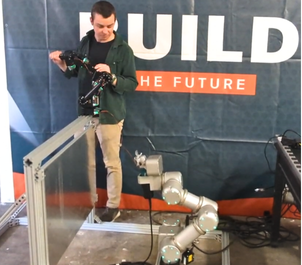
HEBI already had significant experience in integrating haptic data into leader-follower arms. Because of the data-rich nature of HEBI actuators, developing leader-follower systems had been a capability virtually from the beginning of HEBI’s lineup.
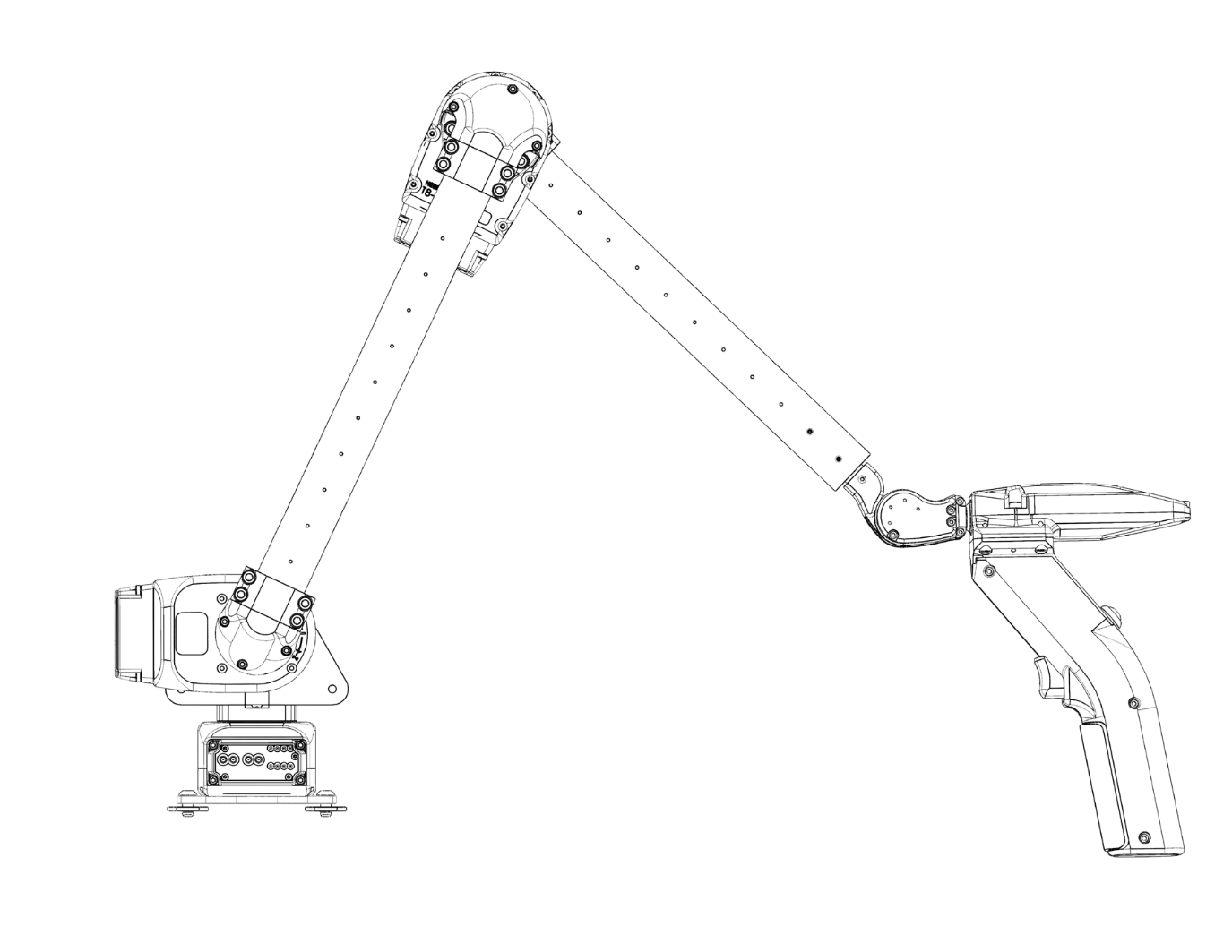
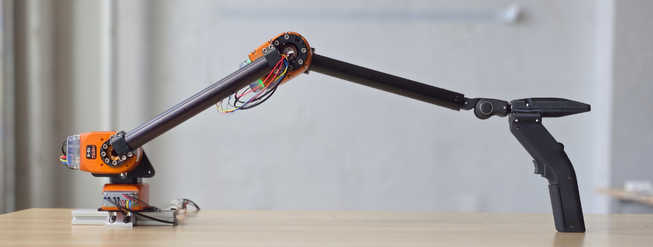
Building on this experience with bidirectional data flow, an arm based on T-Series actuators and a customized sensor package centered around an Inertial Measurement Unit (IMU) was developed.
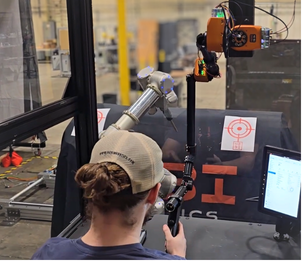
Custom software was written using HEBI’s existing APIs as a starting point. Data on position, torque, and more is fed between the user’s control arm and the arm being controlled. Similar to a leader-follower setup in haptic capability, the system differs from a traditional leader-follower by focusing on end point position control rather than direct joint-level control. HEBI’s bespoke software handles joint-level instructions and provides feedback to the operator for more realistic teleoperation control.
The Result
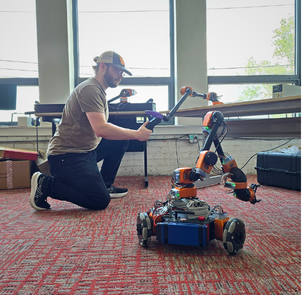
The key benefit of the HEBI Haptic Controller is kinematic flexibility combined with haptic feedback. Rather than the rigid restrictions of 1-to-1 leader-follower arms (which lack control flexibility and typically require significant reprogramming when the kinematics of either arm are changed), the HEBI Haptic Controller can be adjusted to meet a wide range of workspaces as well as control arms with a range of Degrees of Freedom (DoF) or sizes. Minimal code changes allow for significant changes in either the Haptic Controller’s kinematics, or the kinematics of the arm being controlled.
Combined with the haptic feedback available to the operator, the ability to capture haptic data for teleoperation is built-in. When constructing teachable datasets for AI automation, leader-follower data can be inherently inflexible. The HEBI Haptic Controller’s kinematic-agnostic design means easier reconfigurability to match new robot configurations without major retooling. The position data from the Haptic Controller can be used to control virtually any robotic system from arms to AMRs.
From controlling arms in industrial spaces, to AI training applications, to driving mobile platforms, the uses for the HEBI Haptic Controller are limited only by the imagination of a development team. To learn more if the HEBI Haptic Controller is the right fit to control your robot, reach out to us on our contact page.